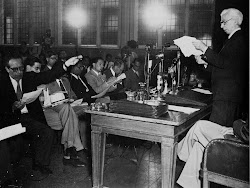
Joseph Rotblat, the only project scientist to leave the Manhattan Project on moral grounds, tells his story in this classic 1985 article,
"Leaving the Bomb Project," in the
Bulletin of the Atomic Scientists.
Leaving the Manhattan Project was a courageous step for Rotblat, and one with serious personal implications. He was accused of being a spy, his personal belongings mysteriously 'disappeared' on his train ride home, and he was not allowed to tell his fellow Project scientists why he was leaving.
"Chadwick ... was shown a thick dossier on me with highly incriminating evidence. It boiled down to my being a spy: I had arranged with a contact in Santa Fe to return to England, and then to be flown to and parachuted onto the part of Poland held by the Soviets, in order to give them the secrets of the atom bomb. ..."
People are often surprised to hear that Prof said he would not rule out working on a similar weapon again in the future. I suspect this was his scientific precision and exact language more than anything else:
"After 40 years one question keeps nagging me: have we learned enough not to repeat the mistakes we made then? I am not sure even about myself. Not being an absolute pacifist, I cannot guarantee that I would not behave in the same way, should a similar situation arise."