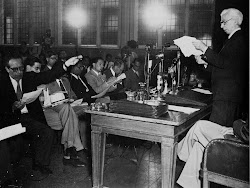
Herb York has died. I would like to share some of his insights: about the imperative of a nuclear weapons free world, and about the Pugwash history.
While a great deal of appropriate attention has gone to the recent ‘revival’ of the notion of a nuclear weapons free world, it is important to note that people like Herb York and others in Pugwash have been out there for decades, paving the way for the many very senior and very important recent voices calling for an eventual end to these horrendous weapons. Here is a quote from York…(from 1971!):
“[O]ur final goal must remain the ideal of general and complete disarmament….Any reasonable extrapolation of history tells us that if we keep all those weapons around they will be used. While no one can say how to get from the present situation all the way to total nuclear disarmament, it is clear that throwing weapons away heads us in the right direction and building more weapons, be they MIRVs, ABMs, or SS-9s, heads us in the wrong direction. We have fussed too much and too long about fine structure. We must begin to focus on directions rather than details.” Herb York, “A Little Arms Control Can be a Dangerous Thing,” War/Peace Report, August/September 1971, pp. 3 - 7_________________________
Following are excerpts from an interview I conducted with Herb York, 28 April 1998.
About the impact of Pugwash:
“The important thing that Pugwash did is it enabled people to meet each other at a time when there were no other good places to do that, particularly East and West. So what matters about Pugwash is not whether they got a certain idea and it doesn’t matter whether or not this idea was adopted. But what matters is that, by example, the fact that Primakov was a member of the Pugwash group and while at Pugwash John Holdren, who is now a member of the White House science advisory committee and Catherine Kelleher, who has been a defense official, were all at the same meetings. That’s what Pugwash did. It got people like them together at a time when there was no other good way for people like them to get together. … And then with others who had other different kinds of connections, like the Kapitsa father and son. The Arbatov father and son. One of the most important of those combinations was Primakov with…Shalheveth Freier….For something like five or six years immediately after the Six-Day War, the primary contact between Moscow and Jerusalem or Tel Aviv was Primakov and Freier meeting either in Pugwash meetings or using that as an alibi for meeting. They were entirely secret, these meetings. They
were fully sanctioned…by both governments. They were the primary way of getting certain detailed messages back and forth.
So the number one thing that Pugwash did was provide a venue. Now the remarkable thing about that was that a lot of people might try to do that. And anybody can identify former officials and invite them to come, but the trick that Pugwash succeeded at was inviting future officials. That’s the trick. That’s the hard part. Primakov wasn’t ex-foreign minister, he became foreign minister.”
“[T]he concrete thing…where [Pugwash was] instrumental in moving immediately to policy was in connection to the ABM Treaty of SALT I. And there it was important. and there one of the important communication channels involved Ruina and Murray Gell-Mann on our side and Millionshchikov and Artsimovich … on their side. They seriously discussed questions of ABM.”
“I thought it was reasonable [that Pugwash received the Nobel Peace Prize]. I thought that they were a likely candidate for some time….And no surprise that within Pugwash Rotblat got it. I mean, Rotblat does stand out….Without him, it probably would’ve collapsed. It’s just simply his determination that kept it going during some otherwise dry years. …Rotblat is very bossy and very opinionated and that’s what enabled him to keep Pugwash together. And it’s not just that he was like that when he was 90, he was like that when he was 70, 60. It’s not just the rigidity of old age. He’s a terribly rigid person, but he has this dedicated purpose to rid the world of nuclear weapons somehow or the nuclear threat. And it’s the kind of
thing that just seizes his whole life. He has dedicated himself to it and the result of that dedication is he kept Pugwash going. …Pugwash would’ve somehow fallen apart years ago or otherwise gotten off the track except for Rotblat’s determination.”Advice to young people:
“It’s a question of odds and the biggest thing is opportunity. Opportunities do come along, the problem is to, when you see one, ditch everything else and take it if it’s a good one. …That often takes, especially if you’re young and have a family…that can be not only gutsy but can even be harmful...if you’ve got other responsibilities. But opportunity comes to everybody and what you have to do is be ready to seize it, no matter what else you’re doing. …give up everything else that’s career-related. That’s where the talent comes in. Opportunities are related to talent in the sense that you have come to somebody else’s attention because of some talent, even if it’s just for comity, some talent. But the real trick is to then recognize the opportunity and do something about it.”
--------------------------
Please click here for the New York Times obituary (web version, 24 May 2009).
Please click here for the Physics Today obituary (21 May 2009).
Please click here for an obituary from the LA Times (21 May 2009).
Please click here for the obituary from the San Francisco Chronicle (22 May 2009).
Bruce Larkin's website contains (with Herb's permission) the full text of Race to Oblivion: A Participant's View of the Arms Race (1970). Click here for the link.
Here is "Reminiscences from a Career in Science, National Security, and the University: Conversation with Herb York," by Harry Kreisler, 6 February 1988. Click here for the link.