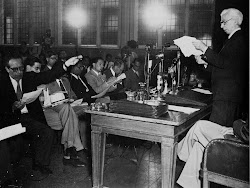
22645 Rotblat
Discovered 1998 July 26 by the Lowell Observatory Near Earth Object Search at the Anderson Mesa Station. ...
Athem Alsabti (Iraqi Pugwash) and Edward Bowell of Lowell Observatory worked together for this designation, which was granted in December 2009.
Thursday, 5 August 2010


Tuesday, 3 August 2010
Bikini Atoll, nuclear tests site - UNESCO World Heritage Centre
Bikini Atoll, nuclear tests site - UNESCO World Heritage Centre: "In the wake of World War II, in a move closely related to the beginnings of the Cold War, the United States of America decided to resume nuclear testing in the Pacific Ocean, on Bikini Atoll in the Marshall archipelago. After the displacement of the local inhabitants, 67 nuclear tests were carried out from 1946 to 1958, including the explosion of the first H-bomb (1952). Bikini Atoll has conserved direct tangible evidence that is highly significant in conveying the power of the nuclear tests, i.e. the sunken ships sent to the bottom of the lagoon by the tests in 1946 and the gigantic Bravo crater. Equivalent to 7,000 times the force of the Hiroshima bomb, the tests had major consequences on the geology and natural environment of Bikini Atoll and on the health of those who were exposed to radiation. Through its history, the atoll symbolises the dawn of the nuclear age, despite its paradoxical image of peace and of earthly paradise. This is the first site from the Marshall Islands to be inscribed on the World Heritage List."
Bikini Atoll Linked with Pugwash History

On 31 July the Bikini Atoll was added to the World Heritage list. The atmospheric testing of hydrogen bombs here led to the first meeting of Bertrand Russell and Jo Rotblat at a BBC studio in April 1954. They were asked to explain the technical aspects and possible impact of the little understood technology following the 1 March Castle Bravo test, which went awry and doused a Japanese fishing vessel, the Lucky Dragon. Their meeting led directly to the Russell-Einstein manifesto of July 1955, and to the first Pugwash Conference in July 1957. Today the crater remains one of the world's symbols of the excesses of the Cold War and a reminder that there is still a long way to go to eradicate these powerful weapons
Monday, 26 July 2010
Pugwash History Featured on Blog
Adele Wick has published a post about the first Pugwash Conference. Please see, "Peace and Pugwash: the 1957 Conference" by clicking here.
And stay tuned, I will soon provide a link to my recent talk on the "Women of the First Pugwash Conference" at Thinkers' Lodge.
And stay tuned, I will soon provide a link to my recent talk on the "Women of the First Pugwash Conference" at Thinkers' Lodge.
Thursday, 17 June 2010
Pugwash history to be explored at July Conference

This exciting conference in Halifax Nova Scotia includes a day at the historic Thinkers' Lodge in Pugwash. It includes multiple sessions on the Pugwash history and nuclear weapons issues, in addition to other topics related to peace education and engaging young people. Director of the Pugwash History Project Sandra Ionno Butcher and several members of Canadian Pugwash are featured speakers. Pugwash history topics to be addressed include: the role of women at the first conference (featuring Ruth Adams and Anne Kinder Jones, later Anne Eaton); the imperative of dialogue in times of crisis; and insights into the bravery and perspectives of the participants at the first conference, as shared by Ru Ling Susie Chou, daughter of Chou Pei Yuan, and members of Cyrus Eaton's family. To register, go to the conference website.
Wednesday, 21 April 2010
Thinkers' Lodge Renovations

Thinkers' Lodge, where the first Pugwash Conference took place due to the generosity of Cyrus Eaton, has been undergoing restoration.
A short story on this from CBC News is available here.
John Eaton tells me they are very pleased with the restoration so far....
The photo above is from July 2009, when the International Student/Young Pugwash board were the last group to stay at Thinkers' Lodge prior to the renovations (I was invited as a resource person). You can see the beginning hints of work on the chimneys.
A short story on this from CBC News is available here.
John Eaton tells me they are very pleased with the restoration so far....
The photo above is from July 2009, when the International Student/Young Pugwash board were the last group to stay at Thinkers' Lodge prior to the renovations (I was invited as a resource person). You can see the beginning hints of work on the chimneys.
Sunday, 24 January 2010
Joseph Rotblat on Charlie Rose, 1996

"A discussion with Nobel Peace Prize-winning physicist Joseph Rotblat, the only scientist to leave the Manhattan Project before the A-bomb was tested. He talks about his signing of the historic Russell-Einstein Manifesto, which called for the end to all nuclear weapons and was the beginning of Rotblat's fifty year fight for total nuclear disarmament."
Thursday, 21 January 2010
Russell at the 1962 Pugwash Conference - Video
Just came across this wonderful short video from the London 1962 Pugwash Conference...
Here's what Russell said about this conference in his autobiography:
Here's what Russell said about this conference in his autobiography:
The Pugwash movement now seems to be firmly established and part of the respectable progress of scientific relations with international affairs. I myself have had little to do directly with its progress in the last years. My interest turned to new plans towards persuading peoples and Governments to banish war and in particular weapons of mass extermination, first of all nuclear weapons. In the course of these fresh endeavours, I felt that I had become rather disreputable in the eyes of the more conservative scientists. The Pugwash movement held a great meeting of scientists from all over the world in London in September 1962. I was to speak about the founding of the movement and I warned my friends that I might be hissed--as I was fully convinced that I should be. I was deeply touched by being given a standing ovation when I rose to speak which included, I was told, all the participants, all, that is, save Lord Hailsham. He was present in his capacity as the Queen's Minister of Science. He was personally, I think, friendly enough to me, but, weighed down by office, he sat tight. That was the last occasion on which I have taken public part in a Pugwash conference.(1)
(1) The Autobiography of Bertrand Russell. Vol III, 1944-1969, Simon, 1969, p. 111.
Thursday, 3 September 2009
Hideki Yukawa
Here is a concise and interesting bio of Prof. Hideki Yukawa, a signatory of the Russell-Einstein manifesto and a participant in subsequent Pugwash Conferences.
http://science.howstuffworks.com/hideki-yukawa-info.htm
http://science.howstuffworks.com/hideki-yukawa-info.htm
Wednesday, 8 July 2009
McNamara and Pugwash--From PENNSYLVANIA to a NWFW

McNamara at the 1990 Pugwash Conference, Egham, England
Robert McNamara, who died 6 July 2009 at the age of 93, will be remembered by the Pugwash movement for his efforts for peace and a nuclear weapons free world during the final decades of his life.
Pugwash: McNamara’s Last Effort for Peace in Vietnam?
His importance to the Pugwash movement began long before he himself was a “Pugwashite”. While he was still Secretary of Defense, McNamara was responsible for convincing President Johnson to allow him to take personal charge of a secret Pugwash back channel to Ho Chi Minh that sought to end the Vietnam War.
The background to this initiative (code named PENNSYLVANIA) began at a June 1967 Pugwash meeting in Paris, attended by three scientists from France, three from the US, two from the Soviet Union, and Joseph Rotblat as Secretary General, where a “formula to stop the escalation of the war” emerged. Henry Kissinger, one of the US participants, was also then a consultant to the US President. It was ultimately decided that two Frenchmen, Herbert Marcovich and Raymond Aubrac, a hero of the French Resistance, would take a message directly to Ho Chi Minh. This was possible because Ho Chi Minh was friends with Aubrac and godfather to Aubrac’s daughter. They spent four days in July in Hanoi and met with Ho Chi Minh and the Prime Minister Pham Van Dong and other officials. Upon their return, they were debriefed in Paris by Kissinger. McNamara then gave Kissinger the following instructions, which were approved by the President on 11 August 1967:
MEMORANDUM FOR DR KISSINGER
You may give your contacts the following message and ask that they deliver it to Pham Van Dong:
The United States is willing to stop the aerial and naval bombardment of North Vietnam if this will lead promptly to productive discussions between representatives of the U.S. and DRV [Democratic Republic of (North) Vietnam] looking toward a resolution of the issues between them. We would assume that, while discussions proceed either with public knowledge or secretly, the DRV would not take advantage of the bombing cessation or limitation. Any such move on their part would obviously be inconsistent with the movement toward resolution of the issues between the U.S.
and DRV which the negotiations are intended to achieve…
The U.S. is ready to have immediate private contact with the DRV to explore the above approach or any suggestions the DRV might wish to propose in the same direction. (1)
In a briefing in Paris with Chester Cooper and Henry Kissinger, the Frenchmen asked for a signal to be sent to the Vietnamese of the serious intent of the U.S. On 19 August the President agreed to suspend bombing within a 10-mile radius of Hanoi from 24 August to 4 September to ensure the safety of Aubrac and Marcovich when they were to go back to Hanoi and also to signal Kissinger’s validity as an intermediary.(2) However, something went wrong, and on 20 August there were 200 “weather backed up” sorties flown, “more than any previous day in the war” according to McNamara. He wrote, “Once again, we had failed miserably to coordinate our diplomatic and military actions.”(3) Their second visit was cancelled and while the channel stayed open through October, these negotiations in the latter half of 1967 failed. McNamara, however, credited them with laying the groundwork for the San Antonio accords, “the foundation for the start of the negotiations between North Vietnam and the U.S. in Paris.” (4)
This sentiment is backed up by Vietnamese sources in an interesting book called Argument Without End, in which senior Americans sat down with senior Vietnamese to sort through the various outstanding questions about the Vietnam tragedy. One participant, Nguyen Khac Huynh said, “PENNSYLVANIA did not fail. PENNSYLVANIA proved to us in the Foreign Ministry of the DRV—and to the leadership—that talks were about to begin. As such, it gave tremendous support and encouragement to those of us who were at that moment working on a negotiating strategy. We were very encouraged…. PENNSYLVANIA succeeded several months after it was initiated, because it provided the basis for beginning the Paris peace process. There is your answer. Our ears were not ‘deaf.’ We ‘heard’ you. And we gave you our answer after Tet.” (5)The Tet offensive planning started in March or April of 1967 (6) , and some Vietnamese believed that they would have a better negotiating position after Tet. (7)
Robert McNamara clearly had a personal stake in this initiative. One of the Frenchmen, Herbert Marcovich, wrote, “It was asserted afterwards that the dismissal of McNamara in the autumn of 1967 was linked to the failure of this enterprise…” (8)
McNamara and Pugwash Efforts for a Nuclear-Weapons-Free World
Between 1982 and 2004, McNamara participated in 24 Pugwash meetings, preferring the expert workshops compared to the larger annual international conferences. During this time, McNamara participated in Pugwash meetings in Beijing, New Delhi, Lahore, and Arzamus-16, locales which show his great interest in finding common ground on the central issues that challenge the nuclear disarmament regime. He took part in 15 of a special series of Geneva-based Pugwash workshops on nuclear forces, and two of the Pugwash workshops in the early 1990s on the “Desirability and Feasibility of a Nuclear Weapons-Free-World.” These workshops and the resulting publications were the inspiration for the Canberra Commission, of which he was a member along with then-Pugwash President Joseph Rotblat and current Pugwash President Jayantha Dhanapala. Indeed it is most likely not an exaggeration to say that much of the Pugwash work in which McNamara played a significant role laid the intellectual groundwork for today’s wider acceptance of the goal of a nuclear-weapons-free world.
McNamara was also involved with another initiative that was dear to Joseph Rotblat’s heart: the launching of the WMD Awareness Programme. McNamara came to the UK in May/June 2005 to give a lecture at the Hay Literary Festival, he was supposed to share the stage with Jo Rotblat, but Rotblat was too ill to travel. McNamara’s speech was, according to John Finney, Chair of the WMD Awareness Programme and a Pugwashite, “a stunning occasion” that “grabbed media attention for several days.” As a result of the success of this event, the annual Rotblat Lecture at Hay was instituted. McNamara also visited Jo during while in England, and the two men who had become friends saw each other for the final time.
In a book celebrating Joseph Rotblat’s 90th birthday, McNamara’s essay concluded with the following challenge to us all:
“[W]ith the end of the Cold War, if we act to establish a system of collective security, and if we take steps to return to a non-nuclear world, the twenty-first century, while certainly not a century of tranquility, need not witness the killing, by war, of another 160 (or even 300) million people. Surely that must be not only our hope, not only our dream, but our steadfast objective. I know that some—perhaps many—may consider such a statement so naïve, so simplistic, and so idealistic as to be quixotic. But as human beings, citizens with power to influence events around the world, can we be at peace with ourselves if we strive for less? I think not.” (9)
Notes
(1)Robert S. McNamara, In Retrospect: The Tragedy and Lessons of Vietnam, New York: Times Books, 1995, p. 298.
(2)Ibid, p. 299.
(3)Ibid, p. 299.
(4)“A Life in Public Service: Conversation with Robert McNamara” Interview by Harry Kreisler, 16 April 1996. Available at http://globetrotter.berkeley.edu/McNamara/mcnamara7.html
(5)Nguyen Khac Huynh, quoted in Robert S. McNamara et al., Argument Without End: In Search of Answers to the Vietnam Tragedy, New York: Public Affairs, 1999, pp 300-301.
(6)Luu Doan Huynh, in Argument Without End, p. 296.
(7)Nguyen Khac Huynh, “Our view was that, after Tet, the conditions [for negotiations] would be favorable.” Argument Without End, p. 300.
(8)H. Marcovich, “Pugwash and Vietnam—1967: A Memoir,” Pugwash Newsletter, April 1976, Vol. 13, No. 4 , p. 207.
(9) Robert McNamara, “Reflections on War in the Twenty-First Century,” in Maxwell Bruce and Tom Milne (eds), Ending War: The Force of Reason. London: Macmillan Press Ltd, 1999, p. 102.
Subscribe to:
Posts (Atom)